
On this page
Writing “do not publish more than four articles a day” inside a model prompt looks clear until it runs across separate scheduled jobs. The morning run does not remember what the previous evening published, the Spanish translation runs in an isolated session, and a few minutes of drift around UTC midnight can push a post into the wrong day. On AndroidLab, volume limits do not live in model memory: they live in a local script that reads the publication ledger and decides with an exit code whether a new write is allowed to start.


The principle matches what we documented in our previous piece on resuming an interrupted publication without duplicates: separate what the model writes from the operational constraints that govern the site. Here the problem is not slug duplication, but overall publishing cadence. Without a mechanical brake, an automated newsroom drifts toward overproduction, which is exactly the pattern Google’s spam policies describe under scaled content abuse when output grows faster than real usefulness.
Why ISO weeks and time zones matter more than they look
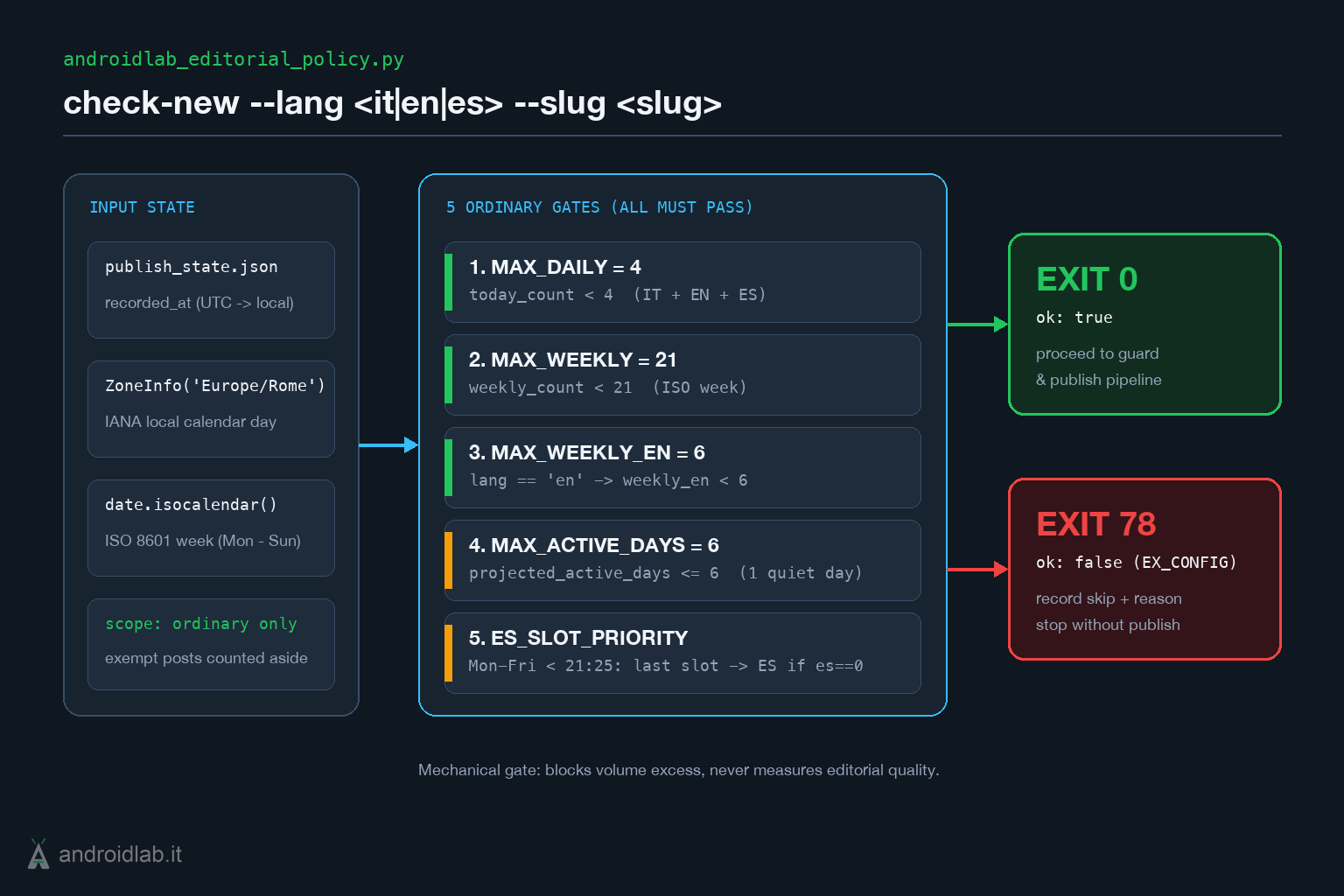
The budget guard reads the local ledger and converts every timestamp into Europe/Rome using Python’s standard zoneinfo library. That is not cosmetic: servers and logs commonly record UTC, while an Italian publication follows local calendar days. A post published at 00:15 Italian summer time still falls on the previous UTC day; if two jobs use different clocks, daily counts disagree.
The same applies to weekly windows. The script computes the current week via isocalendar(), using ISO 8601 weeks from Monday to Sunday. Weekend posts still belong to the closing week, and counters reset only on Monday morning. That avoids a common shortcut in naive automation: counting a rolling seven-day window instead of a clean, auditable editorial week.
Five mechanical constraints on ordinary output
Before an ordinary article is prepared, the check evaluates five limits at once against the same local ledger:
- Daily cap: at most 4 new ordinary articles per day across IT, EN, and ES combined.
- Shared weekly cap: at most 21 new ordinary articles in the ISO week, with no hidden parallel quota per language.
- English weekly cap: at most 6 ordinary EN articles in the same week, preventing the international section from outrunning editorial review.
- Mandatory quiet day: at most 6 active days out of 7. Once ordinary articles have gone live on six distinct days of the ISO week, the seventh day is blocked automatically.
- Spanish slot reservation: Monday through Friday, until at least one ordinary ES article has been published that day, the final daily slot stays reserved for Spanish until 21:25 Europe/Rome; if the ES lane finds no suitable candidate, the slot releases automatically after that time.
If even one rule fails, the command exits with status 78 (historically mapped to EX_CONFIG in sysexits.h) and prints JSON with the exact reason. The job does not negotiate with the cap or invent workarounds: it records a motivated skip and stops.
Explicit exemptions and separate accounting
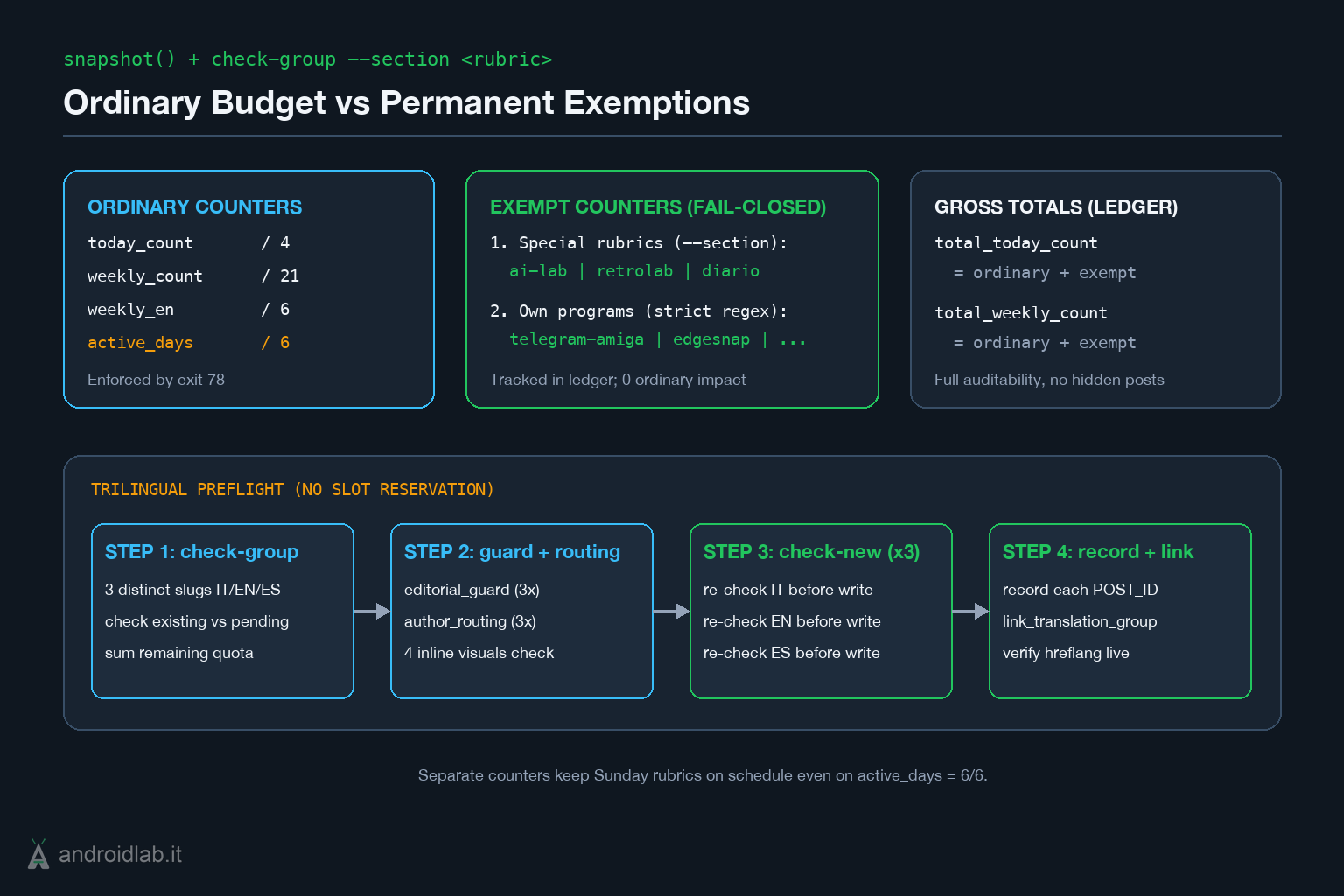
A rigid cap with no documented exceptions invites manual overrides, which is the fastest way to erode discipline. AndroidLab encodes two permanent exemptions directly in the policy file: articles covering in-house software projects (matched via strict slug rules that fail closed if a slug is missing or only vaguely similar) and the three scheduled rubrics (AI Lab, RetroLab, and Diario di Laboratorio), identified by an explicit section parameter.
The key design choice is separate accounting. Exempt posts never vanish from the ledger: they stay recorded and appear in gross totals, while ordinary counters exclude them. Every snapshot reports three distinct figures: ordinary posts, exempt posts, and gross volume. A Sunday rubric issue can publish on schedule even when all six ordinary active days are already used, without distorting daily news metrics.
Group preflight and what actually changes
For a trilingual IT/EN/ES release, checking one language at a time is not enough: you could publish Italian and only then discover that weekly capacity for English is gone. A group preflight (check-group) therefore takes all three exact slugs before the first write, verifies that they are distinct, checks whether any language is already recorded, and sums the remaining budget impact. It does not reserve slots and is not a distributed transaction: each individual language still reruns its own check immediately before publishing.
What actually changes for readers and for a human+AI workflow? The center of gravity shifts. The model is never put in the position of trying to remember a quota or feeling pushed to fill an open slot just to ship something. Code enforces the ceiling and the quiet day; editorial judgment decides whether a topic actually deserves the space.
Where a code guard stops
A Python script can block the fifth article of the day, but it cannot tell a useful analysis from a thin summary. It will not catch a misread primary source, stop a weak story from taking one of the four slots, or repair a ledger edited incorrectly by hand. Mechanical budgeting works only as a seatbelt: it removes pressure on volume, not the need to judge quality.
In short
- AndroidLab enforces volume caps through a local script backed by the publication ledger, not prompt instructions.
- Counts use
Europe/Romeand ISO 8601 weeks (Monday to Sunday), enforcing daily, weekly, EN, Spanish slot-reservation, and 6-active-day limits. - In-house software and scheduled rubrics use fail-closed exemptions with separate counters, keeping gross and ordinary totals transparent.
- Exit code
78stops overproduction, but code does not measure quality: an open slot is never an obligation to publish.