On this page
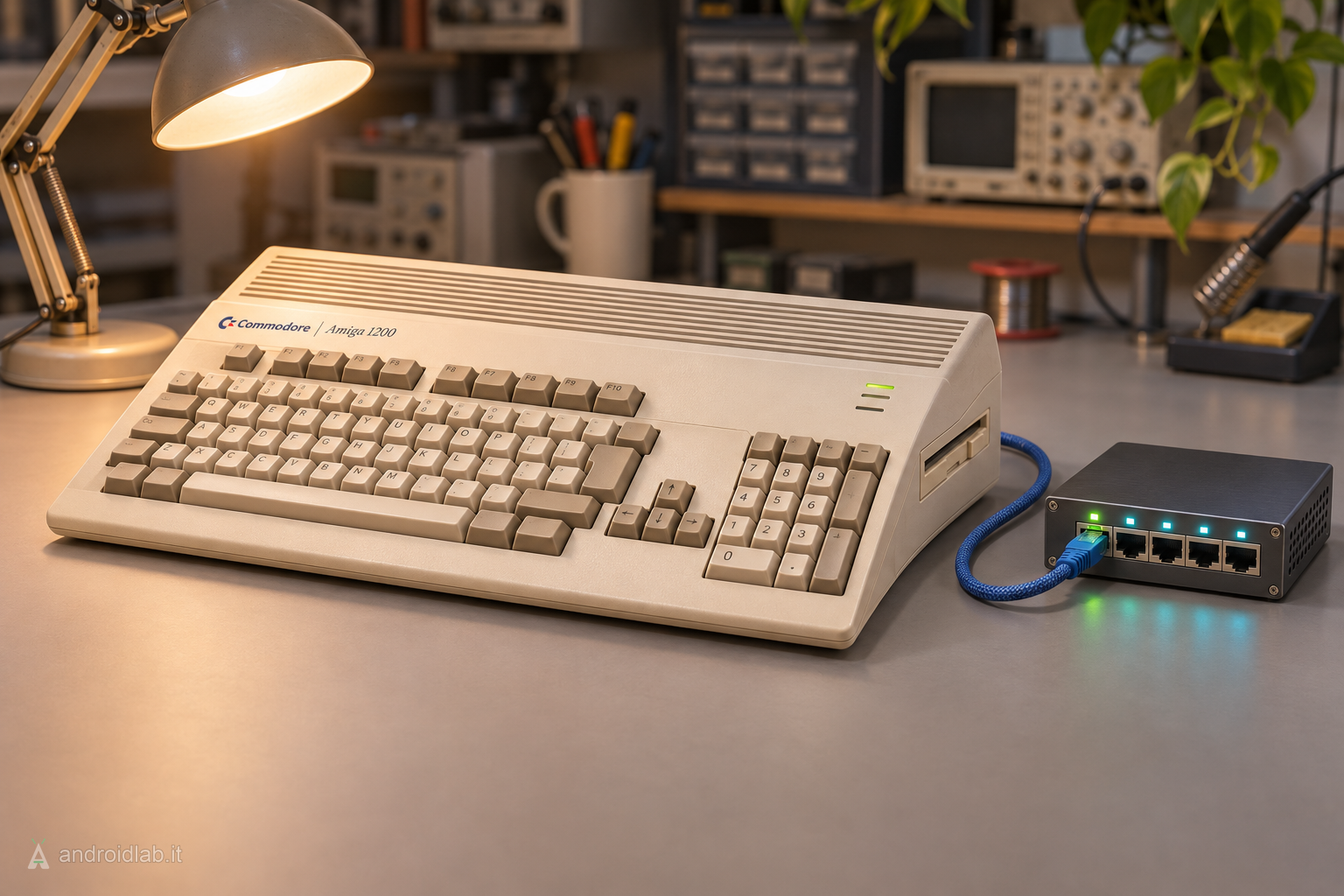
Classic AmigaOS never shipped with a built-in TCP/IP stack. For more than thirty years, putting a 68k Amiga on a network meant choosing among three well-known trade-offs: AmiTCP 3.0b2, free but frozen in 1994; AmiTCP 4.x and Miami, proprietary and effectively unobtainable; or Roadshow, solid and still maintained, yet commercial and closed source. AmiNetXDuo 1.0.0-rc7, released by Tinic Uro on November 20, 2026 on Aminet and GitHub, closes the release-candidate cycle of an MIT-licensed open-source stack speaking both IPv4 and IPv6 from Kickstart 2.04 upward.
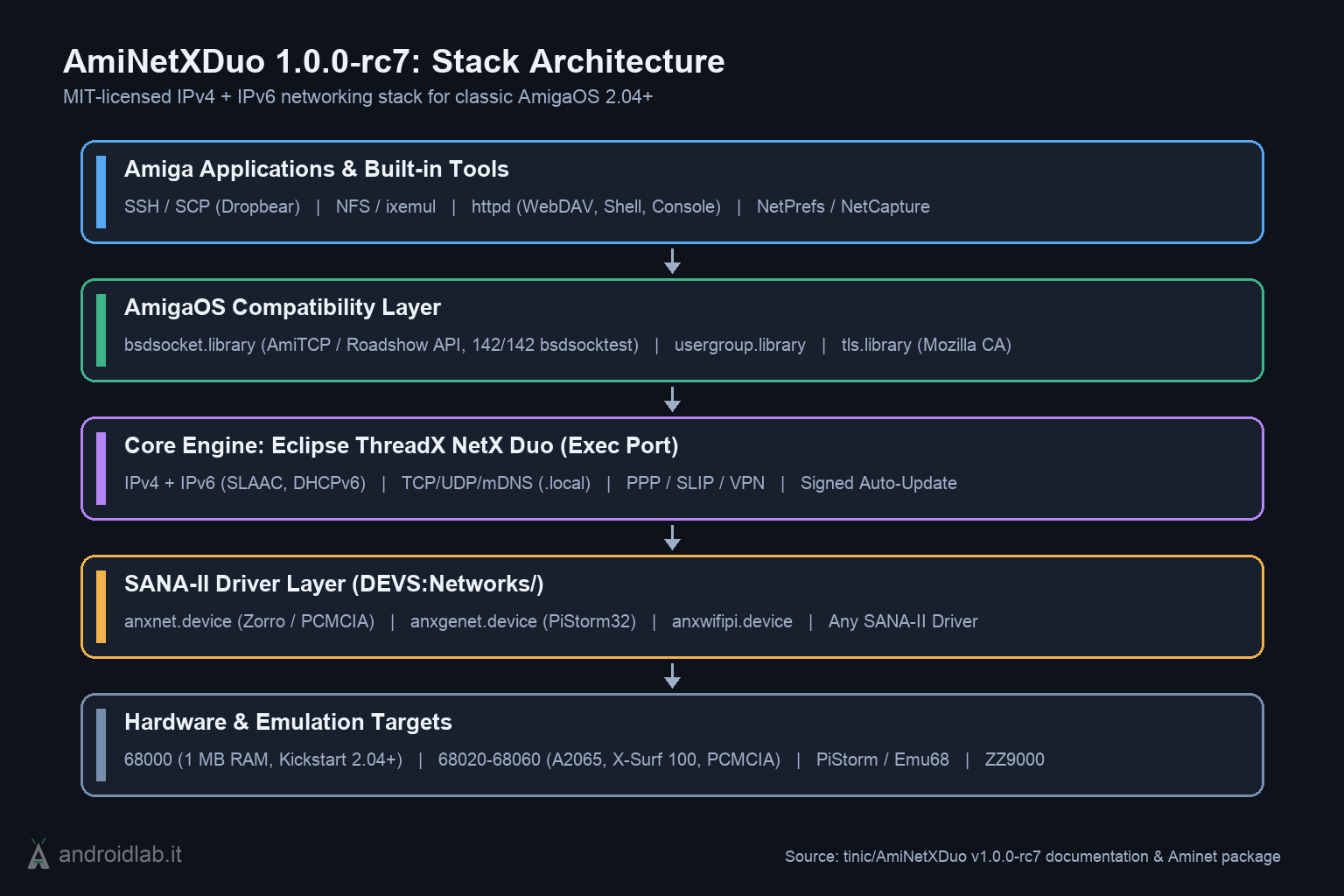
Rather than writing a networking engine from scratch, AmiNetXDuo exposes the standard bsdsocket.library (and usergroup.library) on top of Eclipse ThreadX NetX Duo, an industrial embedded TCP/IP stack ported to Exec. Existing Amiga programs targeting the AmiTCP and Roadshow socket APIs keep working without recompilation, including SSH clients, NFS mounts and ixemul software, while using the same configuration layout under DEVS:NetInterfaces/.
Four stack builds from a 68000 up to PiStorm32
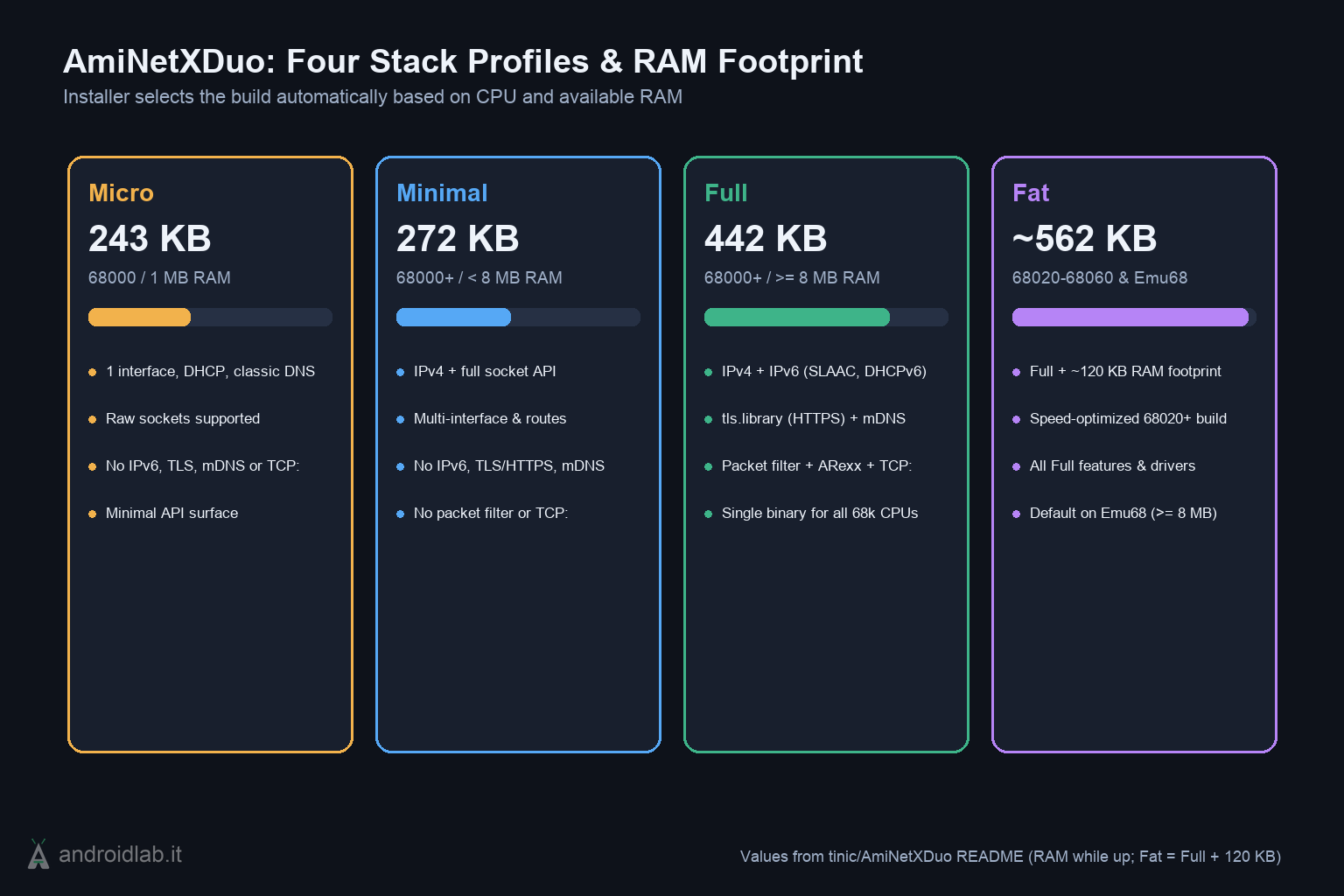
From a systems perspective, memory and CPU scaling is one of the strongest design choices here. A single binary serves every 68k CPU by selecting the appropriate code path when the library opens, with the Fat build being the only 68020+ exception. The 5.8 MB LHA archive ships four profiles that the installer selects according to available RAM:
- Full: all features enabled, around 442 KB of RAM while running.
- Minimal: around 272 KB, omitting IPv6,
.local(mDNS) lookups, the packet filter, HTTPS/TLS, IPv4 multicast, the ARexx host and theTCP:handler. - Micro: around 243 KB, built for 1 MB machines (512 KB Chip + 512 KB Trapdoor) running Kickstart 2.04; it handles a single interface, DHCP, the classic resolver and raw sockets.
- Fat: the full stack, drivers and commands compiled for speed on 68020-68060 and Emu68, using roughly 120 KB more RAM than Full.
On conformance, the project reports 142 out of 142 passes on the independent bsdsocktest suite. Any standard SANA-II driver works, and the archive bundles three native drivers of its own: anxnet.device (covering A2065, Ariadne, Ariadne II, X-Surf, X-Surf 100, X-Surf 500 and PCMCIA cards including NE2000-compatible models, D-Link DL10019/DL10022 and 3Com 3C589), anxgenet.device for Raspberry Pi 4/CM4 Ethernet on PiStorm32 with Emu68 1.1 alpha.1 or newer, and the experimental anxwifipi.device for Raspberry Pi Wi-Fi under Emu68.
What actually changes in 1.0.0-rc7
Release candidate 7 is the final milestone before 1.0.0: the author states that unless a serious regression shows up, 1.0.0 will ship with the same code. The improvements accumulated from rc4 through rc7 target day-to-day reliability on real hardware:
- Signed self-updates with automatic rollback:
UpdateAmiNetXDuocan check once a day at boot for newer builds, verify signatures and file integrity before touching disk, and roll back automatically on the third boot if the network fails to come up. Version rc7 fixes the Check now button in NetPrefs and closes a file-handle leak when starting and stopping interfaces from the preferences tool. - Point-to-point IPv4 and IPv6 links: support for PPP (
ppp.device), SLIP and VPN drivers such asvpn.device, including split IPv6 routing and peer editing in NetPrefs. - Reliable Wi-Fi boot and audio priority: removes the startup race between
AddNetInterfaceandWirelessManager, automatically brings back cards that initially report out of service, and prevents audio dropouts during sustained downloads. - Faster uploads on 68020-68060: longword-aligned frame copies on NE2000, 3C589 and A2065 cards, a documented 3% upload gain on an A3000 with an X-Surf 100, plus
SyncRebootto flush every volume buffer before restarting.
The package also ships tls.library with Mozilla root certificates (usable on Roadshow, AmiTCP and Miami as well), Dropbear-based ssh and scp clients, NetCapture for saving Wireshark-compatible .pcap captures, and an integrated httpd daemon exposing mounted volumes over WebDAV, a browser file manager with a CodeMirror editor, an AmigaDOS Shell and remote display access. On a Zorro III MNT ZZ9000, an optional firmware fork offloads framebuffer readback and delta encoding to the card’s ARM core, raising continuous Workbench window dragging on a 25 MHz A3000 from roughly 0.5 to about 10 frames per second according to project documentation.
Measured throughput and documented gaps
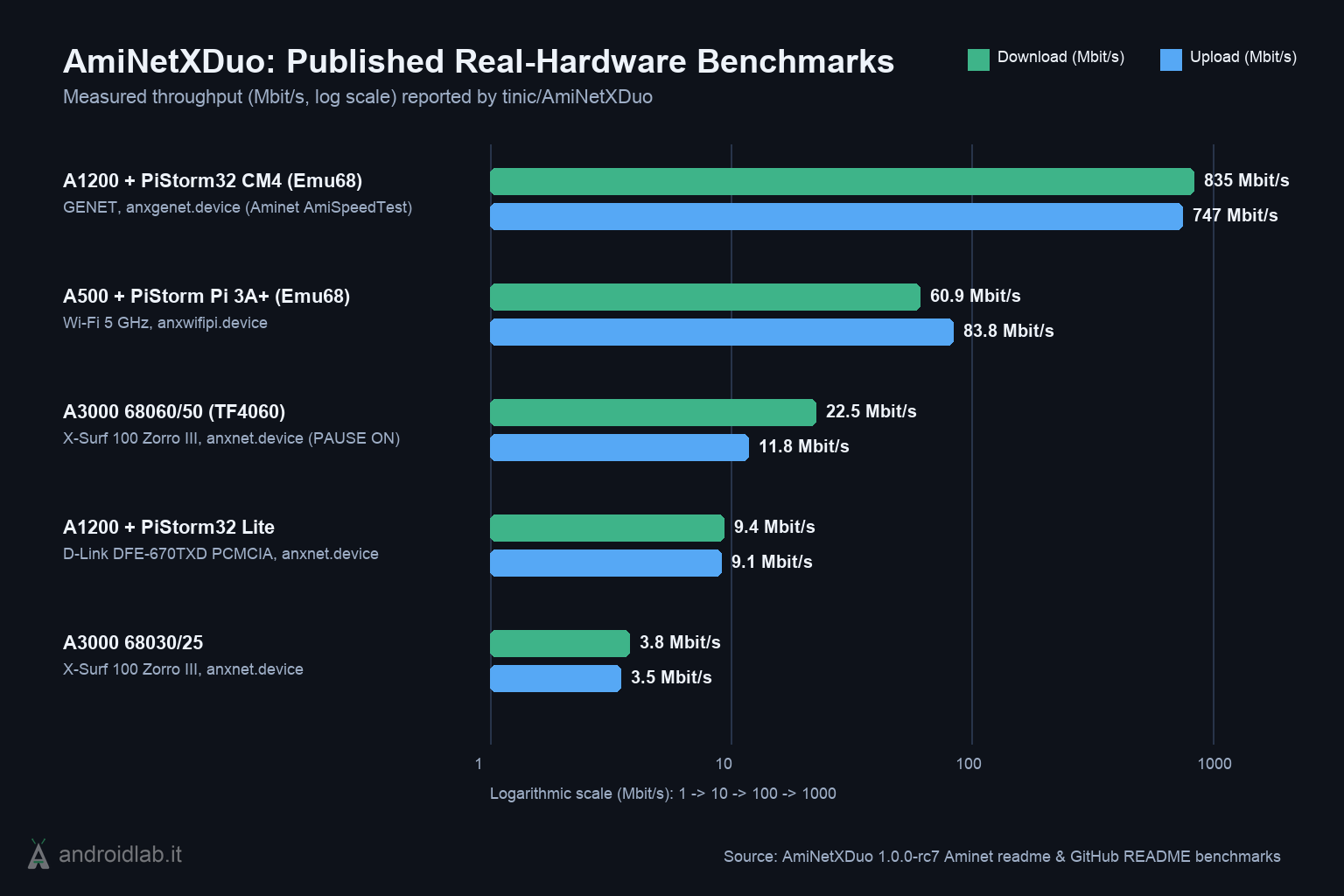
Published benchmarks collected with AmiSpeedTest and iperf on real machines illustrate the range of supported hardware: an A1200 with PiStorm32 Lite and Emu68 1.1 on anxgenet.device reaches 835/747 Mbit/s in the Aminet notes (and up to 900 down / 580 up in the README SANA-II extension test), an A3000 68060/50 with an X-Surf 100 hits 22.5/11.8 Mbit/s with IEEE 802.3x flow control enabled on the switch port, and an A500 with PiStorm on a Pi 3A+ over 5 GHz Wi-Fi reaches 60.9/83.8 Mbit/s. An initial TLS handshake takes about 4 to 9 seconds on a 68020 (one to two minutes on a 68000), dropping under a second on subsequent connections thanks to persistent session caching in DEVS:Internet/tlssessions.
Just as valuable is the honesty of docs/GAPS.md, which spells out what is missing compared to Roadshow 1.15: there are no ipf_* vectors for IPF firewalling or NAT, no RoadshowData runtime tunables for RoadshowControl, no mbuf_* kernel buffer API (NetX Duo uses NX_PACKET instead) and no automatic Punycode translation for internationalized domain names. In addition, the built-in httpd shell and display server has no password protection, so it belongs strictly on trusted local networks.
This push toward open, maintainable system components for classic AmigaOS sits alongside other active efforts in the ecosystem, including Zune68 Beta 5 on the GUI side and BebboGet 1.11 for HTTPS tooling on AROS. AmiNetXDuo 1.0.0-rc7 is available from Aminet and the GitHub releases page (requires a 68000 or better, AmigaOS 2.04+, 1 MB RAM to run and 2 MB to install).
In short
- What it is: MIT-licensed IPv4+IPv6 TCP/IP stack for AmigaOS 2.04+ built on Eclipse ThreadX NetX Duo, compatible with
bsdsocket.libraryand Roadshow interface files. - New in 1.0.0-rc7: final candidate before 1.0.0; NetPrefs fixes, signed self-updates with automatic rollback, PPP/SLIP/VPN IPv4 and IPv6 support, cleaner Wi-Fi startup and faster 68020-68060 uploads.
- Footprint and drivers: four builds (Micro 243 KB, Minimal 272 KB, Full 442 KB, Fat for 68020+); includes SANA-II drivers for classic cards and PiStorm/Emu68 Ethernet/Wi-Fi alongside full third-party SANA-II support.
- Known limits: no
ipf_*firewall/NAT, noRoadshowControlruntime tunables, no IDN Punycode and no authentication on the built-inhttpdweb shell and console.