On this page
Independent Android developers who monetize their apps from home face a concrete privacy dilemma. Under updated Google Play policies tied to European and UK consumer protection rules, every active developer account must declare whether it operates as a “trader” or “non-trader” by February 1, 2027. Starting March 1, 2027, Google will publicly display the physical address and phone number of individual developers classified as traders, not only inside Europe, but to Google Play users worldwide.

The policy stems from Google Play’s transition to an online marketplace model in the European Economic Area (EEA) and the United Kingdom, aligning with transparency duties under the EU Digital Services Act (DSA) and UK consumer law. Yet the way Google has implemented the rule goes well beyond regional compliance, turning a European consumer-protection obligation into a global exposure of personal contact details for solo developers.
Who counts as a trader and what gets published
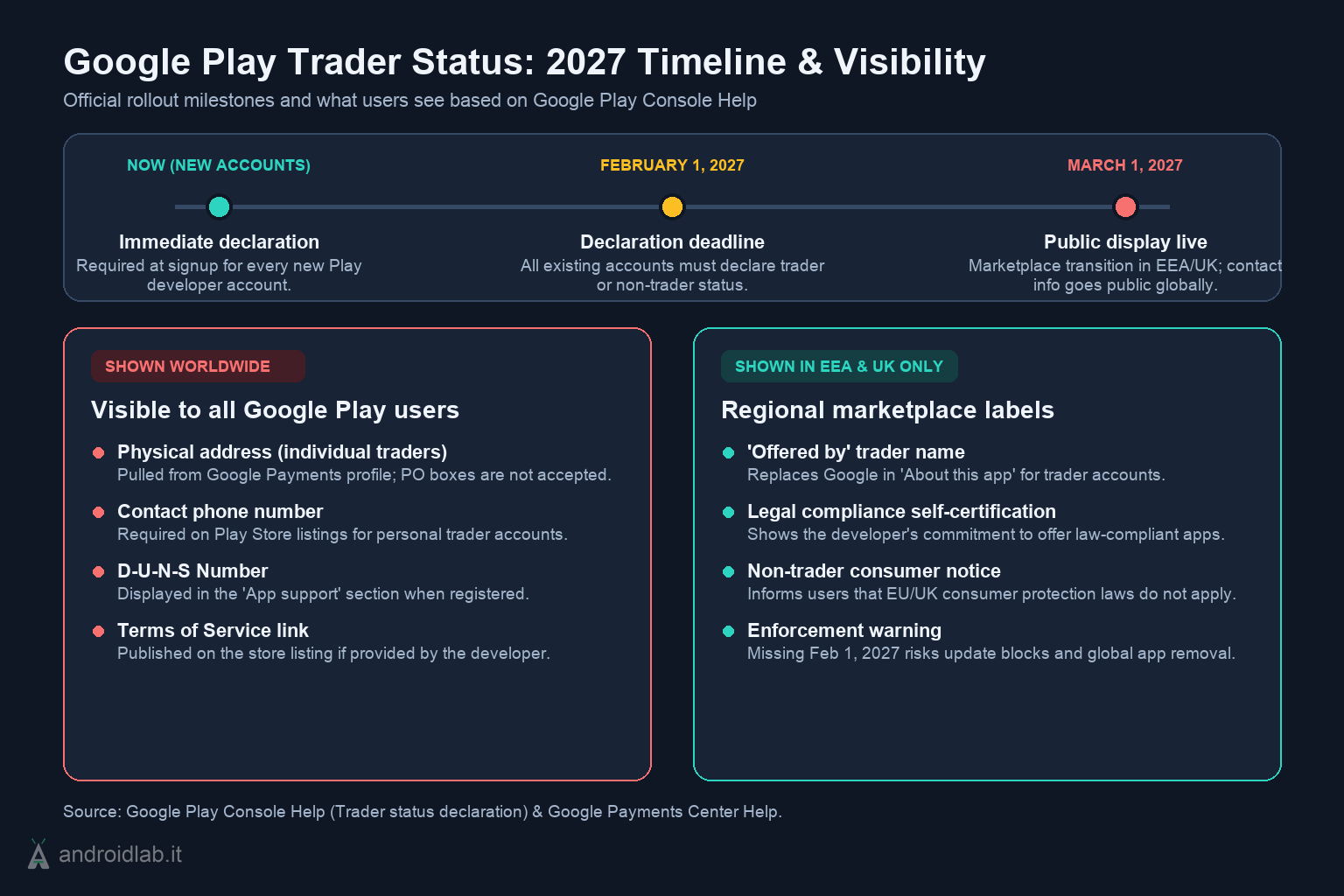
According to Google Play Console Help, every active developer account must submit a trader status declaration regardless of where its apps are distributed. New accounts must complete the declaration immediately at signup, while existing accounts have until February 1, 2027.
Google points to European Commission criteria to help developers assess their status. You are likely classified as a trader if you distribute apps in the EEA or the UK and earn regular or commercial revenue from paid apps, in-app purchases, or ad-sponsored titles, manage publishing as a business, or hold a commercial legal status such as a D-U-N-S number. Two exemptions exist: hobbyists acting strictly outside a commercial purpose, and developers who do not distribute apps in the EEA or the UK at all, both of whom can declare as non-traders.
For developers who declare as traders, Google’s own documentation confirms that starting March 1, 2027, Play Store listings globally will show:
- Contact details: for personal developer accounts classified as traders, both a contact phone number and the account’s physical address.
- D-U-N-S number: displayed in the “App support” section when applicable.
- Terms of Service link: shown on the listing if provided by the developer.
Inside the EEA and the UK, users will also see the developer’s trader name replace Google in the “Offered by” field under “About this app,” alongside the developer’s self-certification that their products comply with local law. If a developer declares non-trader status, European and UK users will instead see a notice stating that statutory consumer protection rights do not apply to contracts with that developer.
The PO box problem and the global scope
The sharpest privacy friction comes from how Google sources the address. Google pulls the legal address from the developer’s merchant payments profile, and Google Payments Center policy explicitly states that PO box addresses are not permitted: developers must provide a valid physical address that matches official documents.
For a company with a registered headquarters, publishing a street address is routine. For an independent developer or solo game creator working from an apartment, it means exposing a residential address and phone number to anyone with a browser or Android phone anywhere in the world. As The Verge and South Korean outlet The Elec reported, some indie developers are already weighing whether to rent a private office or pay for a registered-agent business address solely to keep their home address off the Play Store.
Privacy critics in South Korea have also questioned whether global publication conflicts with data minimization principles such as Article 3 of South Korea’s Personal Information Protection Act (PIPA), which requires data controllers to collect and share personal information only to the extent strictly necessary for the stated purpose. When a regulation applies to the EEA and UK, publishing a solo developer’s home address to users in the United States, Asia, or Latin America is a platform design choice, not a legal mandate.
Google Play vs. Apple App Store on DSA compliance
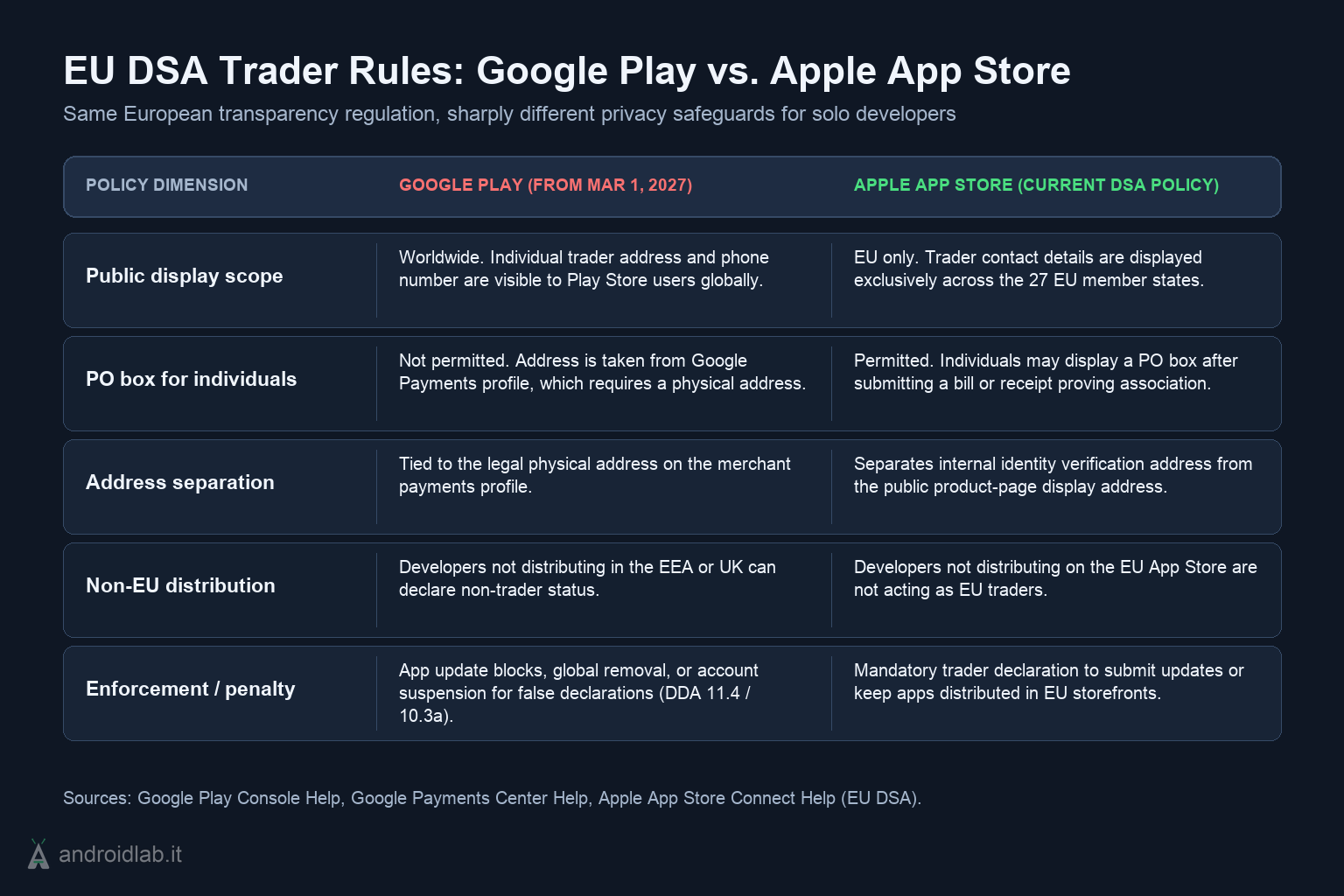
Apple operates under the same EU Digital Services Act obligations (Articles 30 and 31), yet Apple’s App Store Connect documentation shows two major privacy safeguards that Google has not adopted:
- Regional visibility: Apple displays trader contact details only on App Store product pages within the 27 EU member states, rather than broadcasting them globally.
- PO box allowance for individuals: Apple separates the verified identity address kept on file from the public display address, allowing individual developers to publish a PO box as long as they submit a bill or receipt proving their link to it.
The contrast matters because it proves that regulatory compliance and personal safety are not mutually exclusive. Verifying a developer’s real identity privately behind the scenes while letting solo creators list a verified PO box or restricting public display to the jurisdictions that require it satisfies consumer-dispute traceability without turning an app listing into a doxxing vector.
What actually changes for indie developers and Android users
This policy lands alongside other structural shifts in how Google governs Android software distribution, including stricter identity checks and Google’s upcoming 2027 sideloading friction changes. Taken together, the direction is clear: publishing software on Android is becoming more formal, more traceable, and costlier for one-person studios.
Ignoring the deadline is not an option. Google warns that failing to submit the trader declaration by February 1, 2027 can result in blocked app updates and global removal from Google Play. Misrepresenting your status, such as claiming non-trader status while running a commercial app in Europe, violates Section 11.4 of the Developer Distribution Agreement (DDA) and can trigger global account suspension or termination under Section 10.3(a). Google also notes it may challenge a non-trader declaration if account activity looks commercial.
For everyday Android users in Europe and the UK, the change does bring clearer accountability when buying paid apps or subscriptions: it becomes easier to tell whether you are dealing with a commercial entity covered by consumer law or a hobbyist. The downside is collateral damage to the indie ecosystem. Solo developers who cannot justify the recurring cost of a virtual office or registered agent may simply unpublish their apps in the EEA and UK to keep their home address private, shrinking app choice for European users.
Practical checklist before February 1, 2027
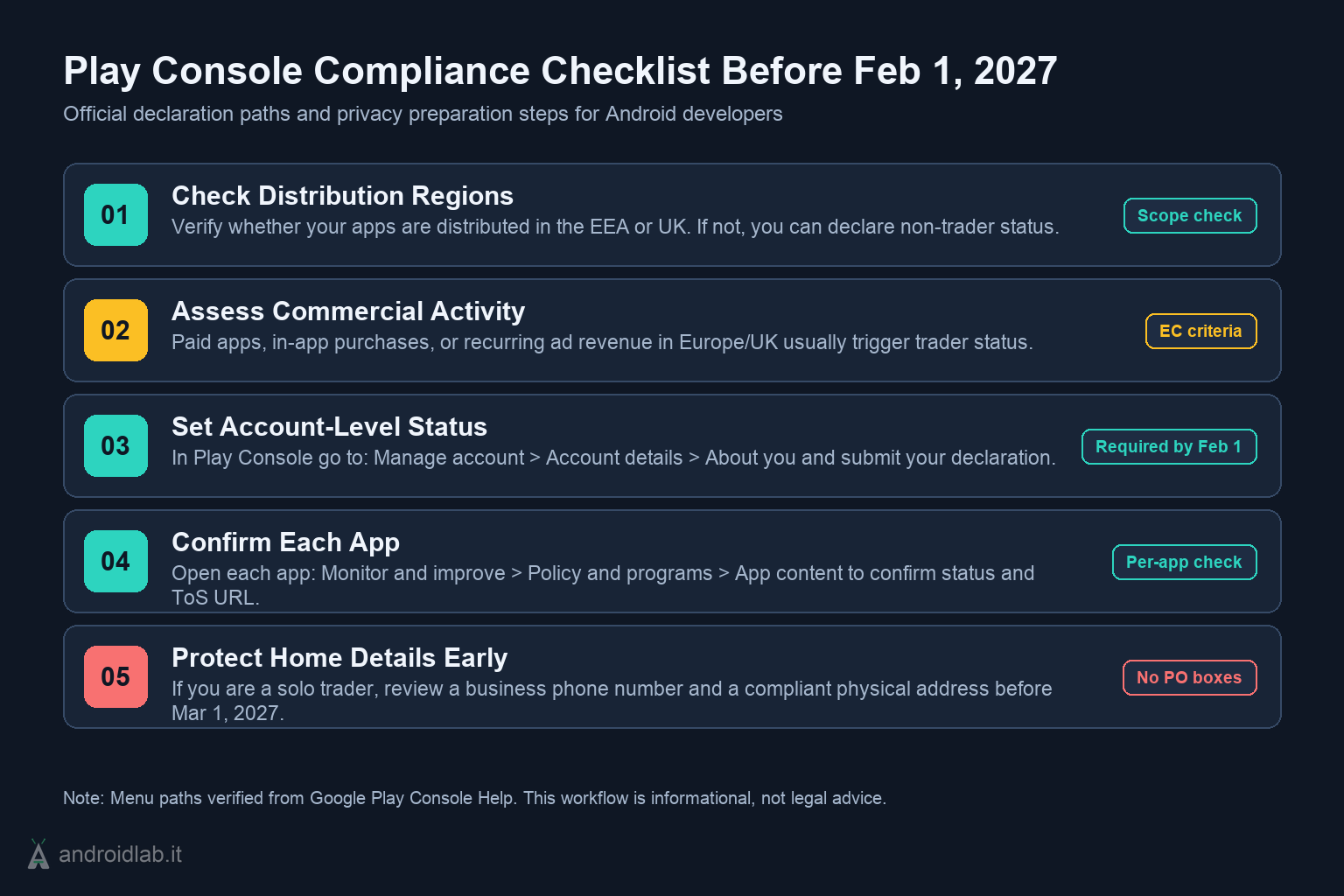
If you manage a Google Play developer account, review your setup well ahead of the deadline:
- Check your distribution countries: If you do not distribute apps in the EEA or the UK, you can legitimately declare non-trader status without exposing personal contact details.
- Audit your monetization model: Paid apps, in-app purchases, and ad-supported apps distributed in Europe or the UK typically fall under trader criteria; if your status is borderline, seek qualified legal advice rather than guessing.
- Complete the account-level declaration: In Google Play Console, go to Manage account > Account details > About you and follow the trader status prompts.
- Confirm each app individually: If you declare as a trader, open each app in Play Console and go to Monitor and improve > Policy and programs > App content to confirm its trader status and add a Terms of Service URL if needed.
- Separate home and business details early: If you are an individual trader who wants to protect a residential address and personal phone number, evaluate a dedicated business phone number and a compliant physical business address or registered agent service before March 1, 2027, remembering that Google Payments profiles reject PO boxes.
In brief
- Declaration deadline: All existing Google Play developer accounts must declare trader or non-trader status by February 1, 2027, or risk update blocks and global app removal.
- Global disclosure date: Starting March 1, 2027, individual developers classified as traders will have their physical address and phone number displayed on Google Play worldwide.
- No PO boxes allowed: Google pulls the address from the developer’s payments profile, which forbids PO boxes, forcing solo developers to expose a home address or pay for a commercial address service.
- Stricter than Apple: Under the same EU DSA rules, Apple limits trader contact display to the 27 EU member states and permits individual developers to display a verified PO box.
- Exemptions: Strictly non-commercial hobbyists and developers who do not distribute apps in the EEA or UK can declare as non-traders.
- Google Play Console Help: Trader status declaration
- Google Payments Center Help: Create a payments profile
- Apple Developer Help: Manage European Union Digital Services Act trader requirements
- The Verge: Android app developers will soon have to share their address publicly (Nov 26, 2026)
- The Elec: Google Faces Privacy Concerns Over Global Disclosure of Developers’ Home Addresses (Nov 25, 2026)