On this page
Anyone maintaining a 68k Amiga with a graphics card knows how long the RTG layer has depended on two closed or commercial stacks: CyberGraphX and Picasso96. With PrismRTG 1.4, released on November 24, 2026 on GitHub under the GPL-3.0 license, developer lainejones pushes this from-scratch open-source replacement for AmigaOS 3.1 and later another step forward, adding 15-bit RGB555 screen modes, native Apollo Vampire V4 SAGA support, and targeted fixes for quick reboots and shadow-mode memory handling.
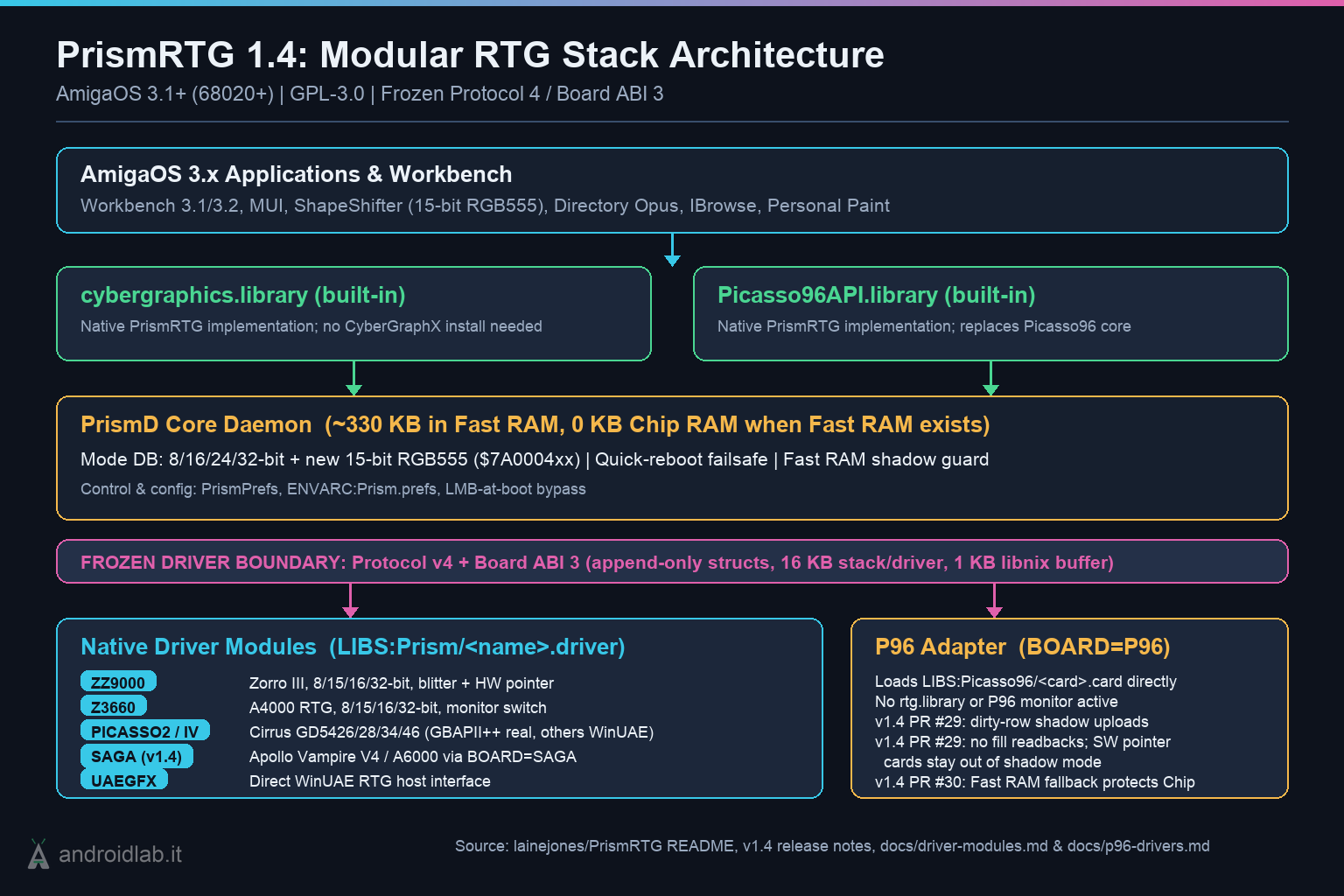
Within a single week, three core components of an open AmigaOS 3 software stack have shipped notable updates: the UI layer with Zune68 Beta 5, networking with AmiNetXDuo 1.0.0-rc7, and now RTG graphics with PrismRTG 1.4. Rather than wrapping an existing commercial core, PrismRTG provides its own PrismD daemon alongside built-in cybergraphics.library and Picasso96API.library implementations, replacing Picasso96 directly on supported boards.
What is new in PrismRTG 1.4
The headline addition in version 1.4 is support for 15-bit screen modes (RGB555) on boards that expose them in hardware, including the MNT ZZ9000, the Z3660 accelerator RTG output, and Cirrus-based boards such as the Picasso II. The modes are disabled by default and can be toggled in PrismPrefs. Two engineering details stand out: on the ZZ9000 and Z3660, the pixel layout matches classic Mac “thousands of colours” modes, saving ShapeShifter from doing software pixel conversion; and the new mode IDs are appended after the 32-bit block ($7A0004xx) so existing screen mode IDs stay untouched across upgrades.
The second major addition is native support for the Apollo Vampire V4 SAGA video subsystem. Previously, Vampire users could run PrismRTG only through the BOARD=P96 adapter wrapping vampiregfx.card. In 1.4, PrismRTG can drive SAGA directly by selecting “Other” in the Board tab of PrismPrefs with BOARD=SAGA in ENVARC:Prism.prefs. Auto-detection is not enabled yet; real-hardware validation was carried out on an A6000 by community tester @HANSolo-0007.
Modular driver architecture, frozen ABI, and RAM footprint
From a systems engineering perspective, PrismRTG’s cleanest design choice is separating the PrismD core from individual board backends, which load as standalone AmigaDOS executables from LIBS:Prism/<name>.driver (falling back to PROGDIR:Drivers). Since 1.1 beta 8, the driver contract has been frozen at protocol version 4 and board ABI 3: a module compiled against this ABI keeps loading in newer PrismD releases, while a driver built for a newer ABI is explicitly rejected before touching hardware.
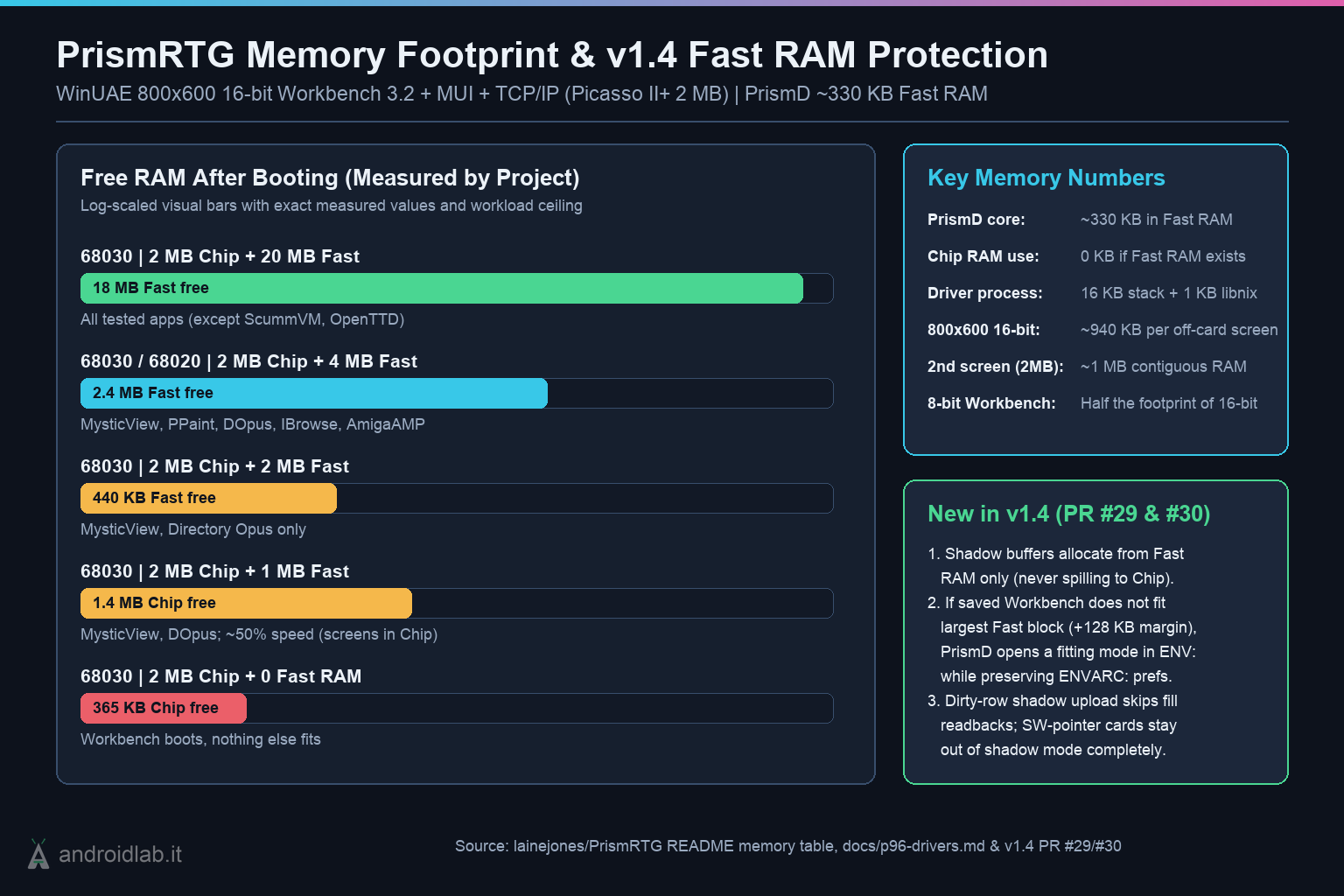
Each driver process runs with a 16 KB stack and lowers libnix‘s standard stream buffer from 64 KB to 1 KB, saving roughly 190 KB per driver process. The PrismD core takes about 330 KB in Fast RAM and none in Chip RAM whenever Fast RAM is present. Based on the project’s WinUAE measurements with Workbench 3.2 on an 800×600 16-bit screen, MUI, and a TCP/IP stack loaded, the practical memory floor is clear: a 68030 with 4 MB of Fast RAM leaves 2.4 MB free and runs MysticView, Personal Paint, Directory Opus, IBrowse, and AmigaAMP, whereas 2 MB of Fast RAM drops headroom to 440 KB. With no Fast RAM at all, Workbench boots with just 365 KB of Chip RAM free, confirming that Fast RAM remains essential for real RTG workloads.
Key fixes in 1.4: shadow mode and quick reboots
Three bug fixes in 1.4 address practical pain points on AmigaOS 3 setups:
- Quick reboots no longer skip PrismRTG: the earlier boot failsafe waited one minute counted in video frames, which do not always advance when only RTG screens are displayed, causing the next boot to bypass PrismRTG. Stable releases now clear the failsafe as soon as
PrismDis running. - Faster shadow mode through the P96 adapter: cards driven via
BOARD=P96that require a Fast RAM shadow copy now upload only modified rows without reading back hardware fills, and cards with only a software pointer no longer enter shadow mode at all (PR #29). - Chip RAM protection on tight-memory systems: if a shadow-mode Workbench does not fit in Fast RAM,
PrismDno longer spills into Chip RAM. Instead, it opens Workbench in a smaller mode that fits for that boot while preserving the user’s saved choice inENVARC:(PR #30).
The release also restores the built-in update check on a stock Amiga 1200 (14 MHz 68020), splits the installer’s final page so recovery tips are no longer clipped behind the Proceed button, and fixes compilation against newer NDKs by including dos/dos.h in cgxvideo.c.
Real hardware versus emulation: what is actually verified
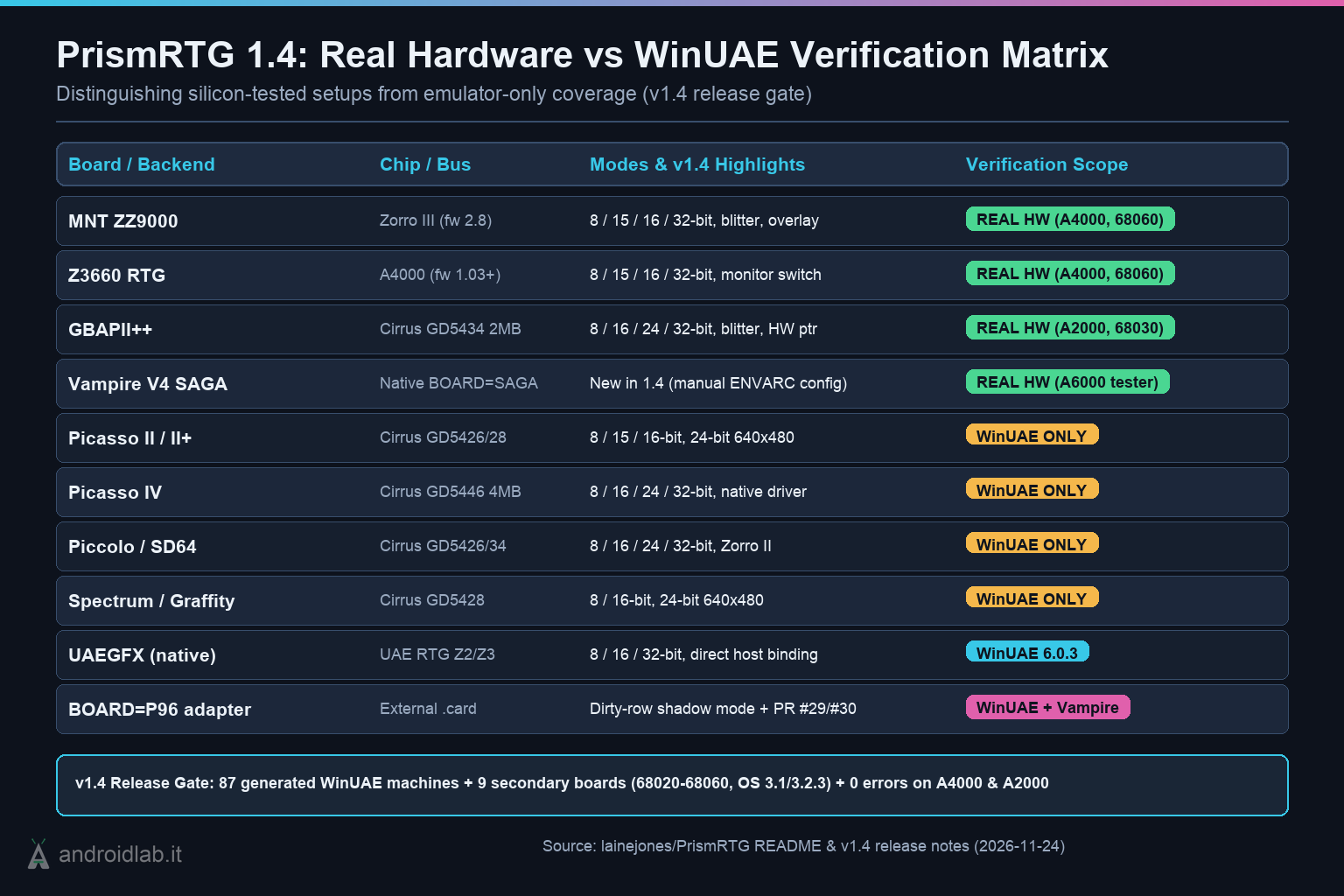
One of the strongest qualities of the PrismRTG repository is how clearly it separates silicon-tested boards from emulator-only coverage. For version 1.4, full installation and reboot verification ran on real hardware using an Amiga 4000 (MNT ZZ9000, 68060) and an Amiga 2000 (GBAPII++, 68030), passing PrismBench, tmpltest, ropcheck, p96test, and cgxtest with zero errors at 8, 16, and 32 bits on both machines and at 15 bits (640×480, 800×600, 1024×768) on the ZZ9000. The Z3660 RTG output on an A4000 was previously validated on real hardware as well, while the new SAGA backend was tested on an A6000.
By contrast, classic Cirrus Zorro boards such as Picasso II/II+, Picasso IV, Piccolo, Piccolo SD64, Spectrum 28/24, and Graffity, along with the native BOARD=UAEGFX backend, are tested in WinUAE emulation only. The automated release gate still exercises 87 generated machine configurations and 9 secondary boards across 68020 to 68060 CPUs on AmigaOS 3.1 and 3.2.3. Owners of original Cirrus Zorro hardware or PiStorm VideoCore setups using BOARD=P96 should treat those paths as experimental, with the comfort that holding the left mouse button at boot always starts the Amiga without PrismRTG.
What actually changes for AmigaOS 3 users
PrismRTG 1.4 does not replace twenty-five years of Picasso96 overnight: vertical RTG screen dragging via the compositor remains experimental, SAGA still requires manual configuration in ENVARC:Prism.prefs, and custom P96 timing files are not imported. Even so, the practical milestone is unmistakable. For ZZ9000, Z3660, GBAPII++, and WinUAE users, there is now a GPL-3.0 RTG stack with a documented frozen driver ABI, shipped as a 355 KB LHA archive and an 880 KB ADF install floppy on GitHub. When a graphics regression hits Workbench, having readable source code and a reproducible test gate beats waiting indefinitely for a closed binary.
In short
- Release: PrismRTG 1.4 (November 24, 2026), GPL-3.0 license, requires Kickstart 3.1+ and a 68020+ CPU (no FPU required).
- Main additions: 15-bit RGB555 modes (matching Mac pixel layout for ShapeShifter on ZZ9000/Z3660) without shifting existing mode IDs, plus direct
BOARD=SAGAsupport for Apollo Vampire V4. - Key fixes: quick-reboot failsafe cleared once
PrismDstarts, dirty-row shadow mode without fill readbacks, and Fast RAM fallback to keep shadow Workbench out of Chip RAM. - Verification: real-hardware passes on A4000 (ZZ9000, 68060), A2000 (GBAPII++, 68030), and A6000 (SAGA); classic Cirrus cards and
UAEGFXverified in WinUAE. - Download:
PrismRTG-1.4.lhaarchive andPrismRTG-1.4.adffloppy image on the official GitHub release page.