On this page
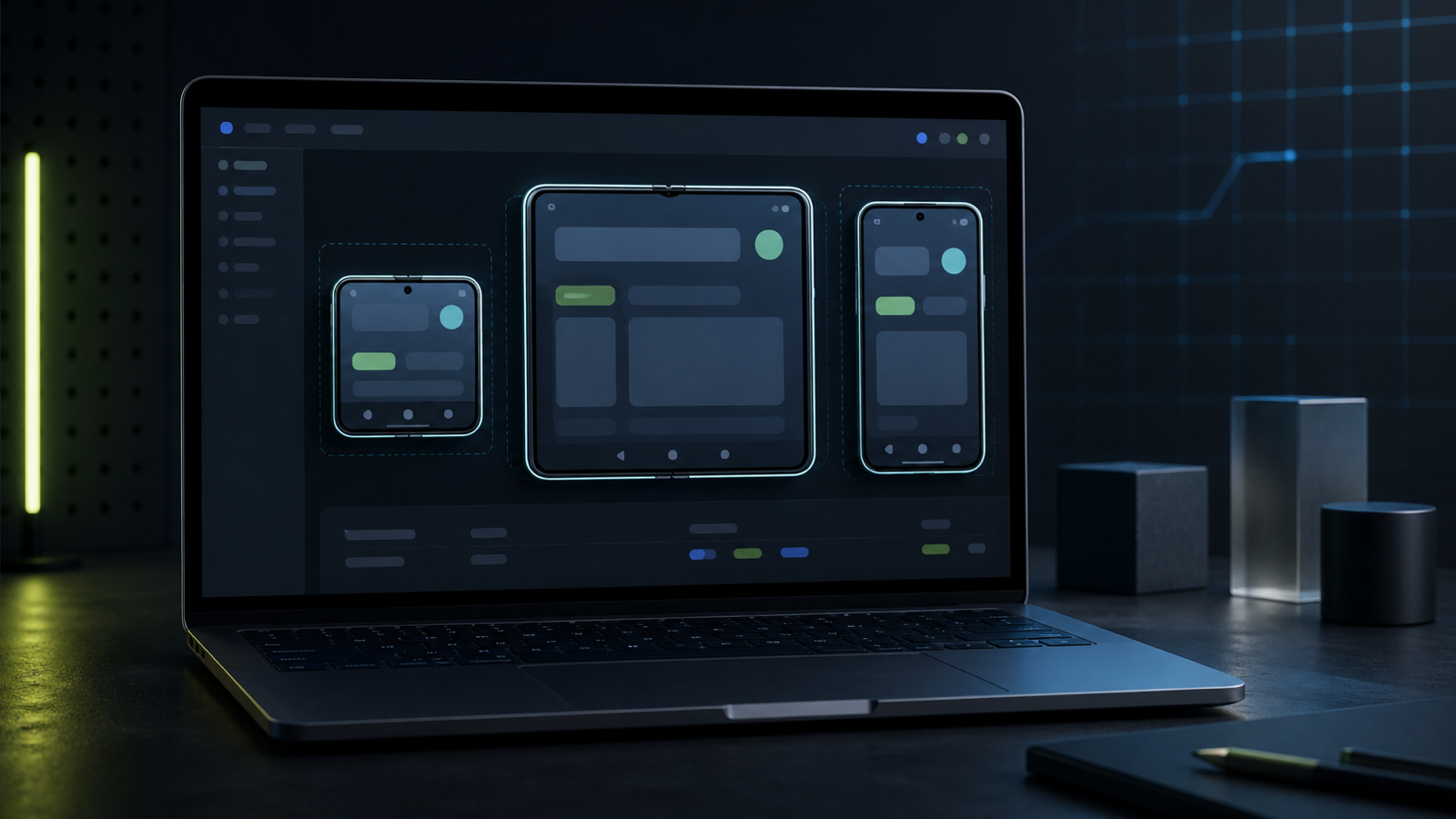
Adaptive Android testing is usually slow for a boring reason: a layout that looks fine on one virtual phone still has to survive a folded cover screen, an unfolded display, a tablet-sized window and an orientation change. Android Developers has now documented a compact set of adb emu commands that lets a running Emulator move through those states from the terminal, without opening a small zoo of virtual devices.

The commands do not replace visual checks or automated UI tests. They remove the repetitive setup between them. That makes them particularly useful when a change must preserve state, keep navigation coherent and avoid a layout snapping into nonsense as the available window changes.
What the new workflow changes
Android Studio already includes the Resizable Emulator for manual form-factor testing. The newer workflow is the ability to send a console instruction with adb emu and immediately get the shell back. With more than one emulator running, target the intended virtual device explicitly:
adb -s <serial> emu <command> <parameter>Find the serial with adb devices, then keep the app open while you change one condition at a time. The practical benefit is repeatability: the same sequence can be placed in a local test checklist or a CI-adjacent developer script instead of being recreated through mouse clicks.
Fold, unfold and rotate without restarting the app
On a compatible foldable virtual device, these two commands switch between the outer and inner display configurations:
adb emu fold
adb emu unfold
After each transition, check the unglamorous things that commonly regress: whether the current screen stays selected, whether typed text survives, whether a modal remains attached to the right window, and whether media or a network request is needlessly restarted. A layout that only redraws correctly after a clean launch has not passed an adaptive test.
Rotation is similarly direct:
adb emu rotateGoogle documents this as a 90-degree clockwise rotation. It is a quick way to expose code that treats a configuration change as a shortcut to resetting the activity rather than a state the app must handle deliberately.
Test a tabletop posture, but query first
Foldable posture IDs are not a universal contract. Start by asking the running emulator what it supports:
adb emu postureThe command reports available positions. Google’s example lists closed, half-opened and opened as IDs 1, 2 and 3; a compatible emulator can then be placed in the half-opened state with adb emu posture 2. Standard templates such as Pixel Fold and the Resizable AVD do not necessarily expose every imaginable posture, so a failed request is a signal to inspect the list rather than invent another numeric ID.
Resize a single emulator across form factors
The Resizable Emulator can also move between its available display presets. Query them before selecting one:
adb emu resize-display
adb emu resize-display 1
In Google’s documented example, the listed presets are phone, unfolded and tablet. The exact index is what the running virtual device reports, not a value an app should hard-code. This matters because it turns one launch into a compact layout matrix: make a change, run a preset, inspect the UI and move to the next one.
A small repeatable test loop
- Launch a compatible AVD and deploy a debug build.
- Use
adb devicesand add-s <serial>when more than one emulator is active. - Navigate to a state with real content: a list, a detail screen, an open keyboard or an in-progress form.
- Run fold, unfold, rotate, posture or resize commands one at a time.
- Verify preserved state, readable hierarchy, touch targets and navigation before moving on.
- Keep the command sequence with the bug report or test case so the regression is reproducible.
The important distinction is between testing a screenshot and testing a transition. Static previews can catch a cramped layout; they do not reveal whether a form drops unsaved input when a foldable opens, or whether a detail pane loses its selection when a window becomes tablet-sized.
Limits worth keeping in view
These commands model display and posture changes, not every property of a physical device. They do not replace checks for thermal behaviour, modem performance, cameras, stylus feel or OEM-specific software. They are also only useful where the chosen AVD supports the requested control. Treat an unsupported posture as a limitation of that virtual device, not proof that a real foldable will behave identically.
For a separate look at testing against the current Android preview track, see AndroidLab’s Android 17 QPR2 Beta 1 eligibility and exit guide. Preview-platform testing and adaptive-window testing answer different questions; a sound release process needs both.
In brief
adb emucan control fold, unfold, rotation, posture and Resizable Emulator display presets from the terminal.- Use
adb -s <serial>to avoid sending a command to the wrong emulator. - Query posture and resize options first; supported IDs and presets depend on the active AVD.
- Test state preservation during transitions, not only the final layout screenshot.
- The controls complement physical-device testing rather than replacing it.
Sources
- Android Developers Blog — Emulator control for adaptive app development (primary source; published August 31, 2026; checked August 31, 2026)
- Android Developers — Run apps on the Android Emulator (official documentation; checked August 31, 2026)
- Android Developers — Get started with adaptive apps (official adaptive-layout guidance; checked August 31, 2026)