On this page
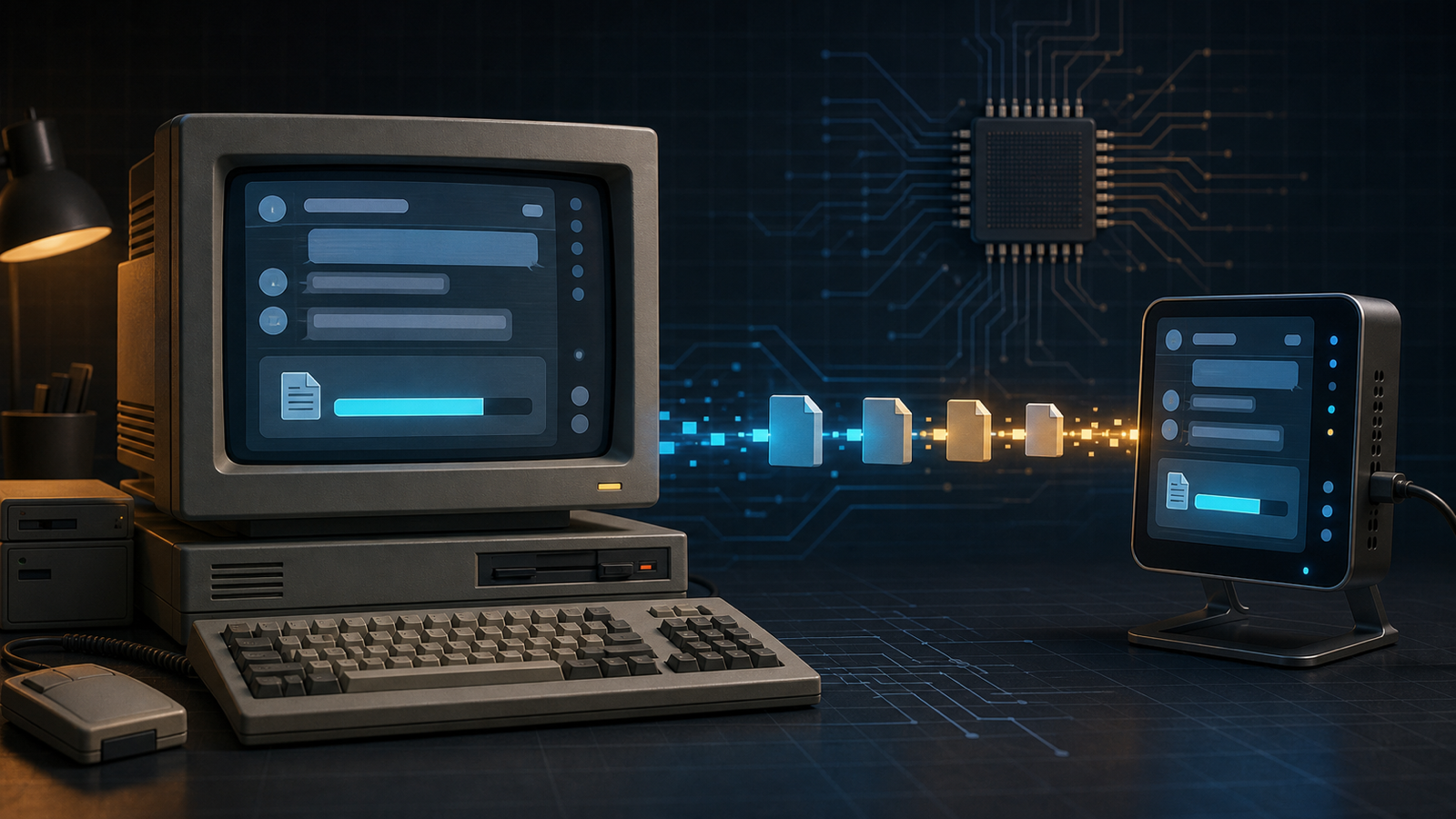
Telegram Amiga alpha 0.0.7 is available from July 24, 2026 for AmigaOS 3.x, AmigaOS 4.x, MorphOS, AROS i386 and AROS x86_64. The release takes the file feature introduced in 0.0.6 into more serious territory: large streaming transfers, live progress, automatic retries and cancellation, with a successful 152 MB test on a PowerPC platform.
The client remains a native MTProto application written in C, with an Intuition/GadTools GUI and a TUI sharing the same engine. Alpha 0.0.7 does not pretend to be Telegram Desktop: it makes the practical path between chats, files and Amiga-like systems more reliable, while adding several everyday usability improvements.
The real jump: robust large-file transfers
The most important change is file transfer. Uploads and downloads now stream data instead of loading the whole document into RAM. The GUI shows a percentage for both directions; when a part fails, the client retries it automatically up to four times instead of discarding the entire transfer.
Network handling has been hardened where a real application tends to die: a wedged socket can be reopened, a write on a link that is no longer writable has a timeout, and the MTProto timeout measures reply inactivity rather than the total duration of the operation. A slow but living connection is not killed merely because an arbitrary wall-clock threshold has expired.
Transfers can be cancelled from the window close gadget or with Esc. Empty files are detected explicitly, while chunk sizes are adapted to the platform: 32 KiB on m68k and 64 KiB elsewhere. The upload path uses saveFilePart for smaller files and saveBigFilePart beyond the relevant API threshold.
The code-calculated limit is 125 MiB on AmigaOS 3.x/m68k and 250 MiB on the other platforms. This should not be confused with the old “31 MiB” still present in one packaging-script line: that is a documentation discrepancy to fix, not the effective 0.0.7 limit. Transfers are still blocking operations in the window for now, and files hosted on another data centre or Telegram’s CDN are not yet covered by the complete path.
GUI: a proper text-editing path
Text composition gets an important small revision. The new Edit menu contains Copy, Cut and Paste; selection works with the mouse and with Shift+arrow keys in both the composer and search fields. The Del key provides forward-delete, and the commands no longer depend on fragile simulated Amiga key combinations.
Double-clicking a message starts a reply, while clicking the composer correctly clears the selected-message state. This is simple ergonomics, but on a GUI that now handles text, history and attachments it matters more than another brochure checkbox.
Live updates and international search
The GUI now receives messages edited from another device, including changes in Saved Messages. The client drains incoming updates while the user is typing without overwriting the composer: the conversation can stay current while the draft remains under the user’s control.
Online peer search also fixes accented characters: the query is transcoded to UTF-8 for Telegram and returned names are converted back to the encoding expected by the target. It is a very practical detail for Italian and international names, and a reminder that “works with English characters” is not a sufficient definition of a modern client.
The TUI enters the file workflow
The text front-end is no longer only a diagnostic mode. The TUI can send and download files through dedicated commands, with Workbench drag-and-drop support. Drop handling has been carried across the AmigaOS 3.x, AmigaOS 4.x, MorphOS and AROS lanes, accounting for the differences between AppIcons, console windows and window targets.
Packagers and maintainers also get the TUI_MODE tooltype, which selects text mode from the icon without shipping separate launchers. The model remains the one introduced in 0.0.6: one TelegramAmiga binary, two Workbench icons, GUI or TUI, without the old IconX script chain.
Cross-platform hardening
The release includes less visible work that is decisive for a family of systems with different ABIs, runtimes and toolchains. The A1222 crash was fixed by using ReadEClock for entropy, the Workbench console task is set before stdio rebinding, MorphOS timer resources are released at shutdown and CON: handles are closed correctly.
The socket library stays open until shutdown to avoid the AROS x86_64 relaunch crash; Classic API, BADDR/SIPTR and Amiga-base handling were also corrected. The full release set now includes AROS x86_64, while version and date are centralized in tg_version.h: 0.0.7, 24.07.2026.
Official downloads: GitHub and Aminet
GitHub archives contain the clients, icons, IT/EN manuals and the public API file. They do not contain Telegram sessions, personal tokens or other private data. Aminet provides the same packages through the canonical paths for all five architectures.
- AmigaOS 3.x alpha 0.0.7, m68k build for 68020 or better; TelegramAmiga on Aminet;
- AmigaOS 4.x alpha 0.0.7, PowerPC build; TelegramAmiga-OS4 on Aminet;
- MorphOS alpha 0.0.7, PowerPC build; TelegramAmiga-MOS on Aminet;
- AROS i386 ABIv0 alpha 0.0.7; TelegramAmiga-AROS on Aminet;
- AROS x86_64 alpha 0.0.7; TelegramAmiga-AROS64 on Aminet.
The official GitHub repository remains the source for code, issues, documentation and current status. For the wider technical story, see the development diary, updated alongside this release.
Project status
The alpha label still matters. Telegram Amiga now handles MTProto login, history, replies, edit/delete, read receipts, avatars, peer search and large files, but it is not yet a complete media client. Inline photos, reactions, full contact management, non-blocking transfers and broader support for files distributed across multiple data centres are candidates for future iterations.
Alpha 0.0.7 is nevertheless a clear threshold: the project is no longer demonstrating only that MTProto can be serialized on an Amiga-like system; a client now has to deal with timeouts, retries, cancellation, encodings, Workbench drops and runtime differences. When retrocomputing works, it is not a postcard from the past. It is a system that can still enter the operational flow of the present.
In short
- Large streaming transfers with live percentage, up to four retries and cancellation from the close gadget or Esc.
- Calculated limit: 125 MiB on m68k and 250 MiB on other targets; a 152 MB PowerPC test is documented.
- GUI text selection, Copy/Cut/Paste, Edit menu, double-click replies and live remote edits.
- TUI file send/download, Workbench drag-and-drop and the
TUI_MODEtooltype. - Accented-name search fixed and platform hardening for AmigaOS 3.x, AmigaOS 4.x, MorphOS, AROS i386 and AROS x86_64.
- Official downloads are available on GitHub and Aminet for every declared platform.
Sources and materials
- GitHub AmigaOS 3.x alpha 0.0.7 release
- GitHub AmigaOS 4.x alpha 0.0.7 release
- GitHub MorphOS alpha 0.0.7 release
- GitHub AROS i386 alpha 0.0.7 release
- GitHub AROS x86_64 alpha 0.0.7 release
- Aminet TelegramAmiga
- Aminet TelegramAmiga-OS4
- Aminet TelegramAmiga-MOS
- Aminet TelegramAmiga-AROS
- Aminet TelegramAmiga-AROS64
- Official Telegram Amiga repository
- Telegram Amiga development diary