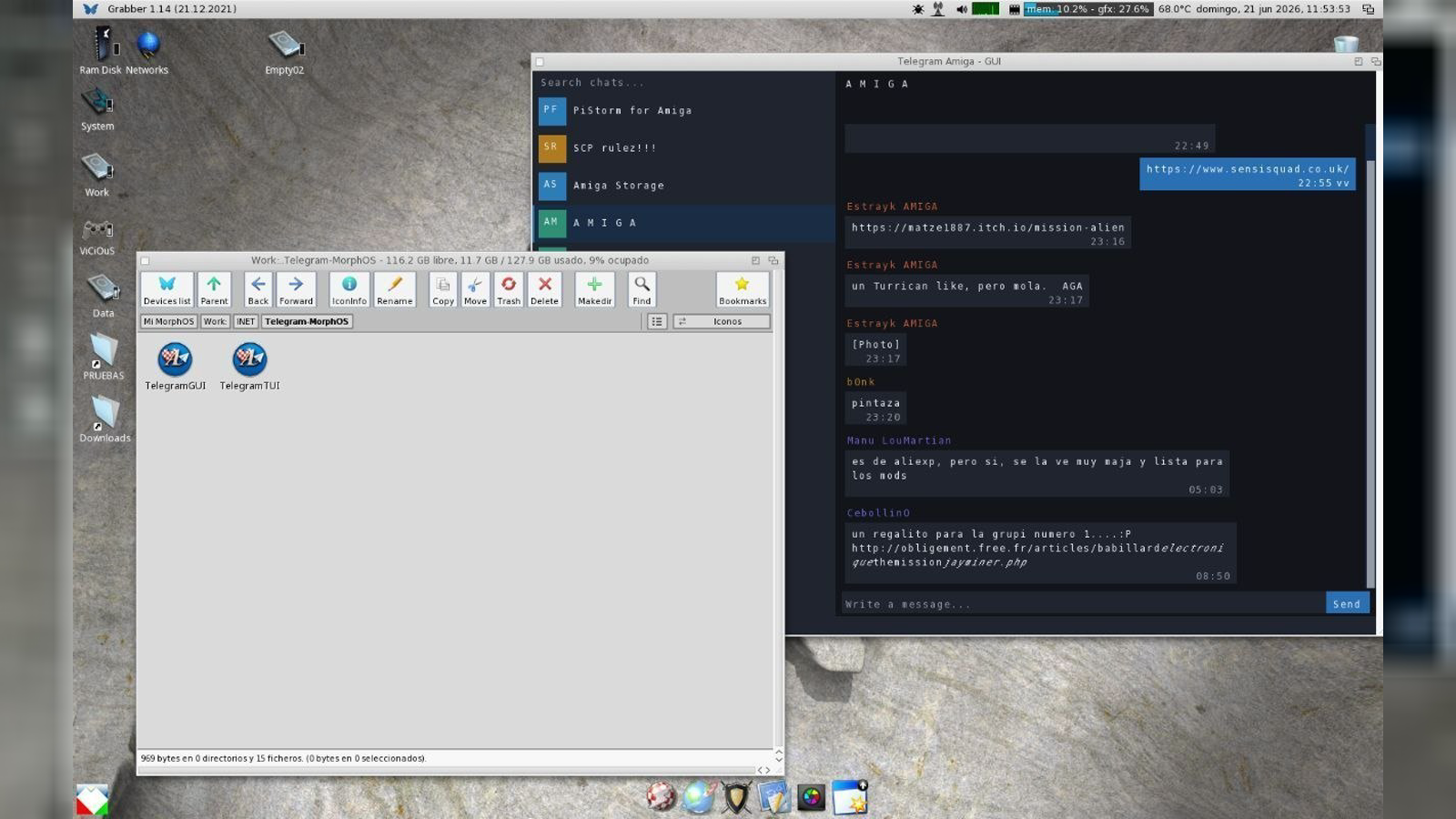
Telegram Amiga has hit a new threshold: it’s no longer just a text-only MTProto client for Amiga-like systems, but an alpha 0.0.1 with a native graphical interface released for AmigaOS 3.x, AmigaOS 4.x, MorphOS, AROS i386 and AROS x86_64. The decisive piece landed with the MorphOS build on June 20, 2026, which closes the loop on the main platforms and finally lets us talk about the project as a multi-platform Telegram Amiga client.
That sentence only looks modest if you read it with modern eyes. In practice we’re talking about a Telegram client written from scratch, that uses MTProto, logs in with a real Telegram account, saves a session, shows the chat list, reads and sends messages, handles notifications, typing and read receipts. All of it without a browser, without a web wrapper and without leaning on modern graphics toolkits: the GUI is drawn by the client itself into an Intuition/GadTools window.
In other words: this isn’t a Telegram web page stuffed into a nostalgic container. It’s a native client that tries to bring an actual Telegram conversation onto Amiga-family systems, with all the compromises and rough edges that something like this drags along. The funny part, if you like, is that in 2026 an Amiga window talking to Telegram almost looks more like sci‑fi than many “AI” demos with three gradients and a button.
Update: the project has continued with Telegram Amiga alpha 0.0.3, which adds native replies in the GUI, Telegram-style graphical checkmarks and a smoother window thanks to double buffering.
The alpha 0.0.1 releases
The GitHub repository now exposes separate alpha 0.0.1 packages for the five supported platforms:
- AmigaOS 3.x, m68k build for 68020 or better;
- AmigaOS 4.x, PowerPC build;
- MorphOS, PowerPC build;
- AROS i386 ABIv0, the 32‑bit AROS line that’s most useful for many testers;
- AROS x86_64, for systems with matching kickstart and SDK from the trunk line.
Every package includes two front ends on top of the same engine: TelegramGUI, the native graphical window, and TelegramTUI, the full‑screen text client aimed at more minimal machines or mouse‑less environments. The archives also contain icons, Italian and English manuals and a public project file called telegram-api.txt. What they must not contain are private files such as sessions, peer cache, tokens or personal credentials.
What the GUI does
The GUI follows a simple but very concrete layout: chat list on the left, conversation on the right, composition area at the bottom. It supports scroll wheel, scrollbar drag and arrow keys, live sending and receiving of messages, “is typing” indicator, read confirmations with single or double check marks, and remembers the window size between runs.
The interesting technical point is that this is not a GUI separated from the text engine: both interfaces share the same MTProto core. That means the hard work is done once: authentication, session, dialogs, peers, history, sending and updates. On top of that, the user can choose to run the graphical window or the console client.
The decision to draw the GUI directly, without MUI and without heavy external dependencies, lines up with the project goal: stay portable across very different Amiga-like systems and avoid turning each target into an archaeological hunt for the “right” library. The README is explicit about this: no MUI, no ixemul, no AmiSSL as a product requirement; the cryptography MTProto needs is built into the client.
MorphOS closes the loop
The MorphOS release was the trickiest step in this round, because it required solving startup, shutdown and GUI stability issues specific to that platform. The release notes state that the deep start/exit lockup that had been blocking the MorphOS version has been fixed, and that typing and read receipts now work there as well.
This changes how you read the project. Before, you could talk about a GUI under development on some platforms; now you can say that Telegram Amiga has a public graphical alpha across the declared family: AmigaOS 3.x, AmigaOS 4.x, MorphOS and AROS, with two distinct AROS variants. It doesn’t mean it’s a finished product, but it does mean the base is solid enough to be tried, critiqued and improved by the community.
Real MTProto, not a Bot API shortcut
Telegram Amiga’s story started cautiously from the Bot API, useful to validate networking, TLS, HTTP and diagnostic flows. The current direction, though, is MTProto: the protocol used by real Telegram clients. That brings in much nastier problems than an HTTP call with a JSON reply: cryptographic bootstrap, RSA, Diffie‑Hellman, SRP for 2FA, AES, SHA, persistent sessions and local state.
The GUI matters exactly because of this: it’s not a costume dropped on top of an empty demo. It sits on a core that already handles login with phone number and code, 2FA password when needed, session saved to telegram-auth.bin, real chat list, messages and account permissions. From that angle the graphical window isn’t decoration: it’s the first real public ergonomics around an MTProto engine designed to survive on uncomfortable platforms.
Alpha means alpha
Let’s say it plainly: this is not a replacement for Telegram Desktop yet. There’s no media upload/download, no edit/delete/reactions, no full contact management and none of the polish you expect from a modern daily client. The project itself labels this as alpha 0.0.1: direct messages and groups work, but the edges are still sharp and can cut.
The key point is that the perimeter is honest. The immediate goal is a reliable text and graphical client for messaging, not a full Telegram replica on machines born in a different technical universe. If media and richer features arrive later, they’ll have to land without betraying the portability that currently makes the project interesting.
Why it matters
Telegram Amiga is a retrocomputing project, but not in the museum‑piece sense. This is not just about running a modern program “because we can”. It’s about shrinking a contemporary, complex, encrypted protocol into something small, portable and inspectable enough to run on real or emulated Amiga-family systems.
The GUI makes all this more visible. As long as the project only lives in a console, it’s easy to read it as a lab for a few people. When a window shows up with chat list, conversation, composer and messages that really arrive, the perceptual jump is huge. Not because the GUI is “pretty” in a modern sense, but because it restores something simple: the idea that these systems can still take part in a real conversation.
In short
- Telegram Amiga has published alpha 0.0.1 releases for AmigaOS 3.x, AmigaOS 4.x, MorphOS, AROS i386 and AROS x86_64.
- Each package includes TelegramGUI and TelegramTUI on top of the same MTProto engine.
- The GUI supports chat list, conversation, live send/receive, typing indicator, read receipts and native scrolling.
- The client talks MTProto directly, with no browser or external proxy.
- It’s still an alpha: messages and groups are the first target, media and rich features may come later.
Sources and context
- Telegram Amiga repository on GitHub
- AmigaOS 3 alpha 0.0.1 release
- AmigaOS 4 alpha 0.0.1 release
- MorphOS alpha 0.0.1 release
- AROS i386 alpha 0.0.1 release
- AROS x86_64 alpha 0.0.1 release
- Official Telegram MTProto documentation
- Related: Telegram Amiga alpha 0.0.3 with native replies and graphical checkmarks
- Related: Telegram Amiga becomes a real MTProto client
- Related: Telegram Amiga development diary